Global Insights, Served Family-Style
September 23rd, 2026
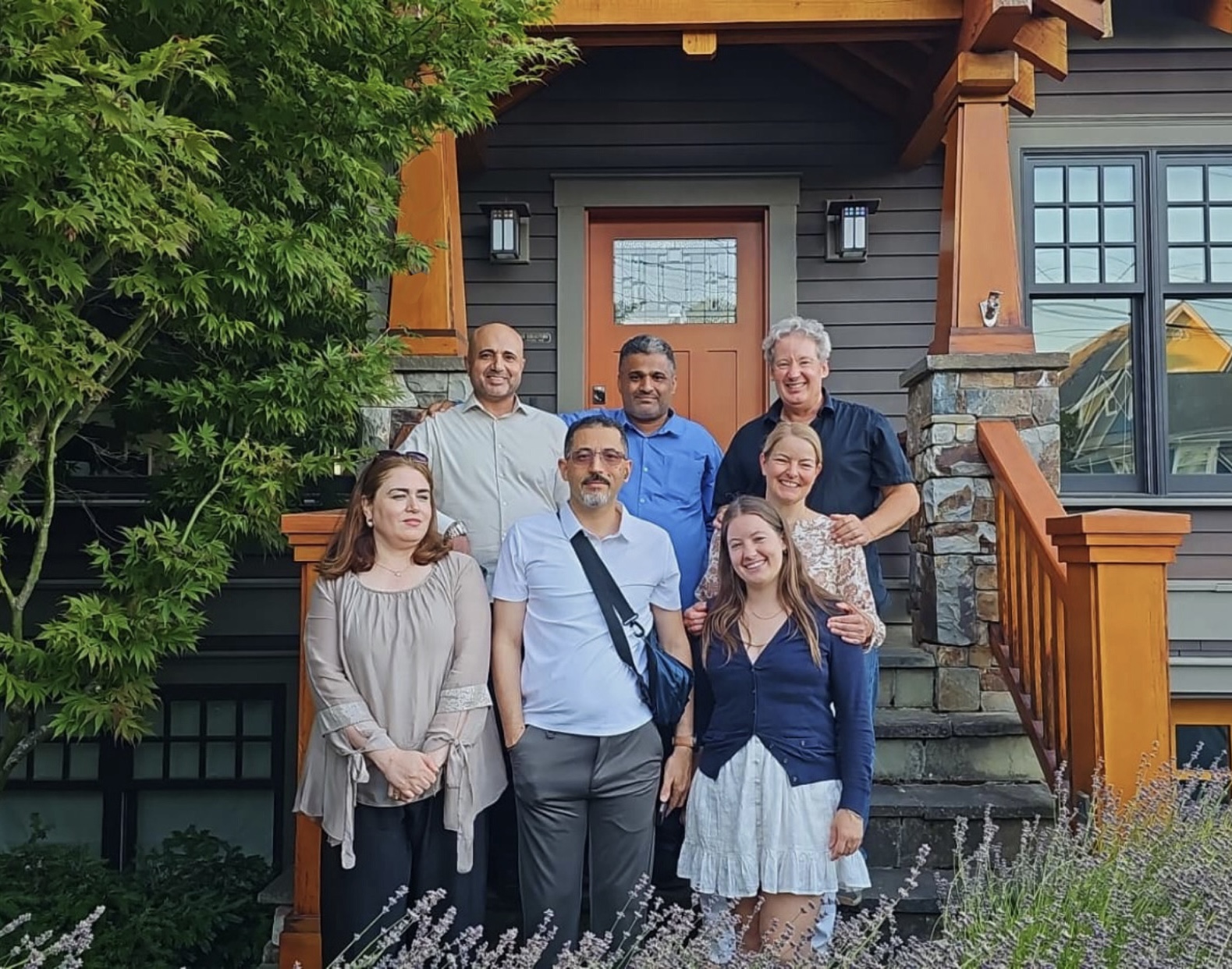
International visitors at a Dinner Diplomacy gathering in August, 2026.
What do you get when an interpreter, four international government leaders, and a family meeting their guests for the first time, all sit down to dinner? It's story my parents and I never expected to tell.
This is Mia, an intern at the World Affairs Council, logging on for my first blog post. I'd like to introduce myself and share my experience hosting international guests through the Dinner Diplomacy program.
I joined the Global Leadership Exchange (GLX) team in June. Before this I had been living in Cairo, studying Arabic and working at a local law firm. I applied to intern with the GLX team because I’m drawn to the idea of person-to-person diplomacy; my experience so far has exceeded all expectations.
GLX is responsible for hosting international guests, who visit Seattle primarily through the International Visitor Leadership Program. Funded by the Bureau of Educational and Cultural Affairs, the program has an 80-year legacy of promoting global understanding through short-term professional exchanges. These exchanges range in themes from history memorialization to search and rescue.
This August, our team welcomed a group of fourteen visitors from Morocco, Algeria, Libya, Tunisia, Lebanon, Jordan, Iraq, and Yemen. The visitors, most of them national security and law enforcement officials, traveled to Seattle as part of their program on combatting transnational crime.
A week before the visitors arrived, I received an email from the World Affairs Council seeking hosts for Dinner Diplomacy, a program pairing international visitors with volunteers for a casual meal in their home. It took some convincing with my parents – we had never hosted unacquainted guests, let alone high-ranking government officials. Nevertheless, the promise of a totally unique experience, one that would enable us to learn about other cultures while sharing the best of our own, ultimately won out.
The following Saturday my parents and I spent the afternoon cooking dinner for eight. We designed a menu to highlight PNW favorites: wild salmon, orzo salad, grilled mushrooms, and blackberry rhubarb pie. As we prepared, we wondered aloud at what the evening might hold. Would our guests be as serious as their titles suggested? Would conversation flow? Would the interpreter mediate every exchange?
At 6:00 pm an Uber pulled into our driveway and four men and a woman got out. They were smiling, taking in their surroundings. At the door they introduced themselves and presented us with flowers and gifts from their home countries. The three guests who spoke English showered us with thanks for welcoming them into our home. Out on the back porch we grazed on appetizers and got to know each other. The two Arabic speakers communicated through Mohammed, the interpreter.
We chatted about their families, work, and what organizations they had visited on their trip so far. I was struck by the humor and levity they brought. One guest had us laughing from the start, as he playfully antagonized the other guests and brought us in on the joke. My mom would later recall the moments in which Mohammed’s interpretation was redundant: “The warmth and smiles between our groups communicated everything that needed to be said,” she remembers.
Over dinner our guests shared their initial impressions of the United States, compared the various Arabic dialects, and traded anecdotes from home. It was a cultural education of the kind textbooks and the news don’t offer. The guests were delighted to indulge my Arabic, meeting each halting attempt with encouragement.
Across town, another Dinner Diplomacy event was revealing its own surprising connections. Gretchen, also from the World Affairs Council, invited neighbors to her dinner – one of whom happened to share a faith and an unexpected history with a visitor. The neighbor's family in India had walked the annual Arba'een pilgrimage route to Karbala, Iraq, along which a guest’s uncle had hosted a rest stop. They learned the neighbor's family may have stopped and been fed at his uncle's rest station! The interaction revealed an unexpected link from across the world, and both parties resolved to help their families meet on the next pilgrimage.
Our dinner was similarly unscripted. In a moment of improvisation, we decided to take our guests for a postprandial walk around the neighborhood. Stopping to pet the bunnies next door and greet neighbors on their evening walk, we strolled to a nearby park. I answered questions about nearby restaurants, local elections, and my experience in public schools. After the walk we continued these conversations over coffee and pie.
The night was over too soon. Gathered again on the front porch, we exchanged promises to stay in touch, our guests insisting we visit their own countries so they could return the hospitality. It was bittersweet to see them go, and we were left with a lasting impression of the connections forged when people from different worlds come together.
I hope you have the chance to experience an exchange like this for yourself. If you have a spare seat at your table and are willing to make room for someone new, please sign up for our newsletter and volunteer for Dinner Diplomacy. It’s refreshing and rewarding. But what does an evening like this mean to the person sitting across the table? One of our guests put it this way:
“The dinner exchange was one of the most meaningful experiences of my IVLP journey. Beyond the wonderful hospitality, it was a genuine human connection, a reminder that diplomacy is often more powerful when people simply open their homes, share a meal, and take the time to understand one another.”
- Sami, Yemen
By Mia McGrath, Global Leadership Exchange Intern and recent graduate in World Politics from Hamilton College.